


Why do you use carbohydrates in Neocate?
Carbohydrates are one of the primary nutrients our bodies need to grow and thrive. Carbohydrates include most fibers, starches, and sugars, and most carbohydrates in our diets come from plants. (Did you know? Glucose – a type of sugar – is the primary energy source for the human brain!) Most children get about 50% of their total energy from carbohydrates. They are essential for health! We combine them with fats, amino acids, vitamins, and minerals to form a nutritionally complete blend of nutrients in Neocate formulas. Some Neocate products contain prebiotics – particular types of fiber that offer benefits. We (humans) can’t digest prebiotics, but some beneficial (“good”) bacteria in our gut can. That’s the main way prebiotics help support digestive health: by supporting good gut bacteria. Learn more about prebiotics. See the table below for the various sources of carbohydrates in Neocate products. Also, here are the main reasons we include them:- Corn syrup solids – as a balanced source of carbohydrates
- Maltodextrin (from corn) – as a balanced source of carbohydrates or a powder “carrier” for vitamins and minerals
- Fructooligosaccharides (oligofructose) – as a source of prebiotic fiber
- Inulin – as a source of prebiotic fiber
- Rice starch – as a natural thickener
- Sucrose (sugar) – for the best taste
How much sugar is in Neocate products?
To answer this question, let’s quickly review what sugars are. First of all, “sugars” are carbohydrate molecules that are one or two units long: mono- or disaccharides. These are also called simple sugars and include glucose and sucrose. Simple sugars are digested and absorbed easily and quickly. Starches are longer carbohydrate molecules. They are digested and absorbed more slowly than sugars. Whiles starches are not sugars, the body breaks them down into sugars. (Fiber and prebiotics, built with different chemical bonds than starch, are also not sugars.)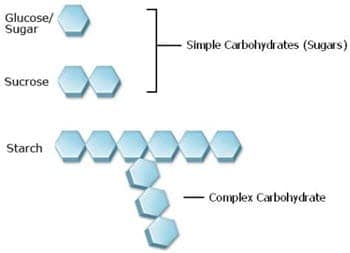
Source: Warrior Wellness
Table Sugars – Carbohydrates in Neocate
| Neocate Products | Carbohydrate source(s) | Total Sugars (per 100 calories) | Added Sugars (per 100 calories) |
| Neocate® Syneo® Infant |
|
0.95 g | None |
| Neocate® Infant DHA/ARA |
|
0.97 g | None |
| Neocate® Nutra |
|
2.6 g | 1.9 g |
| Neocate® Junior, Unflavored (without prebiotic fiber) |
|
0.94 g | None |
| Neocate® Junior with Prebiotics, Unflavored |
|
0.94 g | None |
| Neocate® Splash, Unflavored |
|
5.2 g | 4.7 g |
Neocate® Junior
|
|
0.94 g | None |
Neocate® Splash
|
|
5.1 g | 4.7 g |
| Neocate® Splash, Grape |
|
5.3 g | 4.7 g |
Carbohydrates in Neocate: Why do you add sugars to some Neocate products?
Unlike other formulas, amino acid-based formulas that are plain, or unflavored, can have bitter or sour tastes. (Young infants don’t seem to notice this as much.) This is because amino acids – which are 100% non-allergenic – are the protein source. Our product team adds artificial flavors to make flavored versions for children with the best taste. Sugar is sometimes added to help balance out the flavored versions to taste their best.Do you really need to use sugar?
Some parents ask if we need to use sugars or artificial sweeteners at all. For the flavored versions, sweetness is needed to help the flavors taste their best. We use artificial sweeteners that are safe and approved, and only one per product that works well with the flavor. (Some families prefer to avoid certain artificial sweeteners, hence only one per flavor!) Many parents and healthcare teams have been surprised at the great taste of our unflavored formulas for children. Unflavored versions of Neocate Junior and Neocate Splash all have mild and pleasant tastes without the use of artificial sweeteners. We add some sugar to Neocate Splash to help balance the taste profile and avoid a bitter or acidic taste.What if I want no added sugars?
It’s possible to make flavored formulas without added sugars, but the result isn’t always best. That’s because avoiding sugars usually requires 2+ artificial sweeteners. Since some parents and caregivers prefer one artificial sweetener, that’s what we stick with. Versions made with 2+ artificial sweeteners tend to taste, well, very artificially sweet. In Neocate Junior we have great tasting formula WITHOUT the use of added sugar, and only one artificial sweetener. In Neocate Splash, we combine one artificial sweetener plus some added sugar for a balanced taste. If we can make a good-tasting formula without added sugars, we do. But if it doesn’t meet children’s standards, we won’t do it! Every flavored Neocate formula is backed by extensive taste testing and flavor development. We offer several unflavored options for families seeking a hypoallergenic formula without any artificial sweeteners. We also have flavored Neocate Junior formulas with no added sugars. This table shows you which Neocate products contain a single artificial sweetener and, if so, which sweetener:| Neocate Products | Artificial Sweetener |
| Neocate® Syneo® Infant | None |
| Neocate® Infant DHA/ARA | None |
| Neocate® Nutra | None |
| Neocate® Junior, Unflavored (without prebiotic fiber) | None |
| Neocate® Junior with Prebiotics, Unflavored | None |
| Neocate® Splash, Unflavored | None |
| Neocate® Junior, Tropical | Acesulfame Potassium |
| Neocate® Junior, Chocolate | Sucralose |
| Neocate® Junior, Vanilla | Sucralose |
| Neocate® Junior, Strawberry | Sucralose |
| Neocate® Splash, Grape | Sucralose |
| Neocate® Splash, Orange-Pineapple | Sucralose |
| Neocate® Splash, Tropical Fruit | Acesulfame Potassium |
-Rob McCandlish, RDN
Last updated May, 2020
Published: 02/21/2017